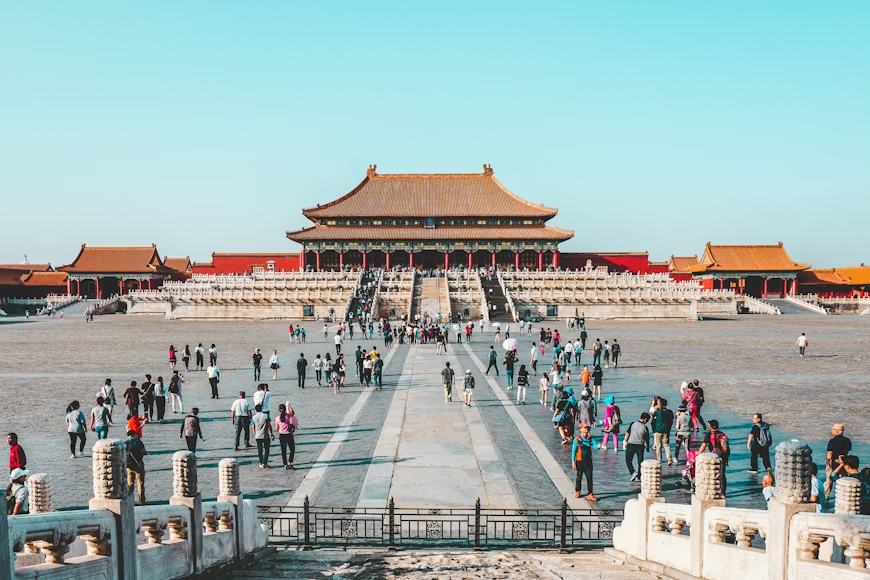
China recorded 888 million domestic tourist trips during October 2025 Golden Week alone, showing how choosing the wrong travel dates can turn a dream vacation into an overcrowded experience. In such cases, the worst time to visit China is when national holidays push travel volumes to extreme levels, regardless of the weather.
The first week of October and the Spring Festival period from late January to early February create the most difficult travel conditions. Spring Festival generates close to 9 billion passenger trips nationwide, overwhelms trains and airports, pushes hotel prices sharply higher, and leaves major attractions packed from opening to closing.
This guide reveals precisely when travel conditions become most challenging in China. You’ll learn why Golden Week creates massive travel volumes in just 8 days, how summer temperatures reach 40°C with suffocating humidity, and effective strategies for managing unavoidable visits during these demanding windows..
Source: Unsplash
What is the Worst Time to Visit China?

Source: Unsplash
The worst time to visit China centers on three high-impact periods. Golden Week from October 1 to 8 triggers massive domestic travel, overwhelms major attractions nationwide, and pushes hotel prices far beyond normal rates.
The Spring Festival travel rush from late January to early February generates massive passenger movement over several weeks, straining transport systems to their limits. July and August add intense heat, with high temperatures and heavy humidity across major cities.
Golden Week causes the most disruption for international travelers. Extreme crowd density, hotels selling out months in advance, and attractions hitting daily capacity limits reduce sightseeing to short, rushed visits with little flexibility.
Suggested Read: China Visa – E-Visa Requirements, Eligibility & How To Apply
Golden Week October Overcrowding: 888 Million Trips in 8 Days

Source: Unsplash
China’s National Day Golden Week makes early October the most crowded time in China, as large sections of the population travel at the same time. The scale of holiday travel places intense pressure on transport systems, hotels, and major attractions nationwide.
Golden Week Visitor Statistics
| Impact Category | 2025 Golden Week Data | Travel Consequence |
| Total domestic trips | 888 million over 8 days | Average 111 million trips daily nationwide |
| Cross-regional passenger flow | 2.43 billion trips (40-day period) | 6.2% increase in daily flows year-over-year |
| Railway passengers (single day peak) | 23.13 million on October 1 | Record-breaking single-day figure |
| Tourism revenue | 809.01 billion yuan ($113.63 billion) | 15.4% increase from 2024 |
Transportation System Overwhelm
The worst months to visit China coincide with Golden Week, when national transport systems operate under extreme strain. China Railway moved about 219 million passengers during the extended holiday period.
Guangzhou South Station alone handled a record number of arrivals and departures on October 1, highlighting why this period became a bad time to travel to China.
- Railway travel reached 23.13 million passengers, the highest daily total on record.
- Road travel involved about 308.9 million people nationwide.
- Air travel handled around 2.47 million passengers in one day.
- Waterway transport carried roughly 1.32 million travelers, showing a sharp seasonal spike.
If you’re planning to travel to China, apply for a China visa with OneVasco for a smooth and stress-free experience.
Attraction Capacity Issues
| Destination | Golden Week Impact | Booking Reality |
| Jiuzhaigou National Park | Tickets for October 2-6 sold out, daily caps hit | Sales suspended on all platforms, standby system only |
| Forbidden City Beijing | Over 17 million annual visitors, peaks during holidays | Advance booking is essential; same-day tickets are unavailable |
| Great Wall sections | Packed walkways reduce meaningful experience | Arrive before dawn or avoid October completely |
| West Lake Hangzhou | Tourist crowds are eliminating the peaceful atmosphere | Constant congestion throughout daylight hours |
Accommodation Price Surges
China’s worst travel months line up closely with Golden Week, when lodging costs rise sharply across major cities and tourist hubs:
- Hotels in Beijing, Shanghai, and Xi’an raise rates sharply during the holiday period.
- Advance bookings become essential, with decent hotels selling out four to six months early.
- Budget hotels and guesthouses often reach full occupancy well before the holiday begins.
- Hostels also fill completely during the holiday period, then cut rates sharply once it ends to recover demand.
Experience Quality Destruction
October falls squarely within the period when not to visit China, as crowd density overwhelms major landmarks and removes any sense of space or calm:
- The Forbidden City turns into a slow-moving human queue, with entry waits stretching for hours.
- Great Wall sections fill shoulder to shoulder, leaving little room to walk or take photos.
- Xi’an’s Terracotta Warriors halls become tightly packed, limiting viewing time.
- Shanghai’s Bund viewing areas crowd quickly, making movement difficult.
- Guilin Li River cruises run at full capacity, removing the quiet atmosphere many expect.
Suggested Read: China With Kids: Fun Things to Do Together
Spring Festival Travel Chaos (Late January-Early February)

Source: Unsplash
Spring Festival triggers the world’s largest annual human migration and marks late January through early February as a bad time to travel to China. Transport systems operate at full capacity, which places this window among the worst travel months for reliable movement and access.
Spring Festival (Chunyun) Statistics
| Period | Passenger Volume | Transportation Mode |
| 40-day travel rush total | 9 billion trips | Historic high, 7% year-over-year increase |
| Railway trips | 510+ million | Daily average of 12.75 million passengers |
| Air passengers | 90+ million | Exceeding previous holiday records |
Why Spring Festival Creates Travel Nightmares
Spring Festival stands as China’s most important holiday, when families reunite across the country. Around 1.4 billion people travel during this period, and the worst weather in China often overlaps with these dates, compounding crowd pressure and transport strain. Travel difficulties during Spring Festival include:
- Train tickets are selling out within minutes of release, which requires booking the moment sales open.
- Railway platform data show about 297 million tickets sold for the Spring Festival period.
- Ticket scalping drives up prices despite enforcement efforts.
- Hotels near hometown destinations are reaching full occupancy.
- Roads are facing extreme congestion, with most trips taken by car.
Eight-Day Holiday Impact
The eight-day Spring Festival holiday from January 28 to February 4, 2025, concentrated travel demand into a very short window and pushed national systems to their limits:
- Domestic passenger trips reached about 501 million during the holiday period.
- Tourism spending totaled roughly 677 billion yuan.
- The cross-regional movement exceeded 2.3 billion people nationwide.
- Return travel peaked on the final day, overwhelming rail, road, and air networks.
- Cross-border travel reached 14.37 million trips, a 6.3% rise year over year.
Regional Considerations
| Region | Spring Festival Conditions | Travel Challenge |
| Northern China (Beijing, Harbin) | Temperatures -10°C to -25°C, ice festivals crowded | Extreme cold with a massive tourist influx |
| Southern China (Guangzhou, Kunming) | Warmer weather attracts northern tourists | Hotels are fully booked, prices tripled |
| Major transportation hubs | Guangzhou, Beijing, and Shanghai are overwhelmed | 5+ million trips daily at peak |
| Tourist attractions | Theme parks, scenic areas at capacity | Tickets peak between New Year’s Eve and Lantern Festival |
Cultural Tourism Explosion
Spring Festival’s recognition as a UNESCO Intangible Cultural Heritage event in 2024 sharply increased domestic travel tied to cultural activities:
- Intangible cultural heritage tourism bookings rose by about 40% year over year.
- Events like Quanzhou puppet shows and the Shanghai Yuyuan Lantern Festival reached full capacity.
- Holiday box office revenue hit 9.51 billion yuan, drawing large crowds to cinemas.
- Around 187 million people attended movie screenings.
Suggested Read: China on a Budget 2026: Affordable Travel Guide
Summer Heat and Humidity (July-August)

Source: Unsplash
July and August bring the worst weather in China, with temperatures climbing to 40°C and humidity levels that make heat feel overwhelming. Outdoor sightseeing becomes risky, especially in large cities. Many travelers rely on indoor spaces for long stretches of the day to avoid heat stress and exhaustion.
Summer Temperature Extremes
| City/Region | July-August Temperature | Humidity Reality |
| Beijing | 25-38°C, peaks above 35°C | High humidity increases discomfort significantly |
| Shanghai | 28-35°C, urban heat island effect | Humidity combines with heat, making 30°C feel like 40°C |
| Wuhan | 28-33°C average, peaks 40°C+ | Known as “furnace city,” the extreme heat-humidity combination |
| Chongqing | 28-34°C average, peaks 40°C+ | Another “furnace city,” with poor air circulation |
Heat Index and Health Dangers
Apparent temperatures, which reflect how heat and humidity feel on the body, rise to around 50°C in central provinces such as Hubei and Hunan during peak summer. Southern provinces like Jiangxi and Guangdong face similar conditions, affecting populations comparable in size to Spain and Mexico combined.
China’s Sanfu season, a traditional marker of peak summer heat, runs from mid-July through late August. This period brings the most oppressive conditions of the year..
Regional Summer Conditions
The best and worst time to visit China varies dramatically by region during the summer:
Northern China (Beijing, Tianjin, Shanxi):
- Temperatures reach 35°C+ daytime
- Occasional thunderstorms provide brief relief
- Hot and rainy conditions July-August
- Best outdoor activities before 10 am or after 4 pm
Eastern China (Shanghai, Hangzhou, Nanjing):
- 25-32°C with frequent scorching weather
- High rainfall throughout the summer months
- Urban heat island effect intensifies temperatures
- Humidity makes the temperature feel 5-10°C higher
Central China (Wuhan, Changsha, Chongqing):
- 28-34°C average, regularly exceeding 40°C
- “Furnace cities” designation due to extreme heat
- Humidity blocks air circulation, creating oppressive conditions
- Heat waves can last weeks without relief
Southern China (Guangzhou, Guilin, Hong Kong):
- 28-35°C with heavy rainfall
- Monsoon season brings rainstorms and typhoons
- Extremely humid conditions throughout the summer
- Coastal areas experience typhoon disruptions
Tourist Impact During Summer
July and August stay busy due to school vacations, even though they rank among the worst months to visit China from a weather standpoint. High travel volume collides with extreme heat, reducing comfort across major destinations.
- Domestic travel spikes during the 50-day school holiday period.
- Major attractions face overcrowding alongside intense heat exposure.
- Hotel rates rise despite uncomfortable outdoor conditions.
- Sightseeing outdoors becomes physically draining and requires frequent rest.
- Air conditioning shifts from a comfort feature to a basic necessity.
Heat Mitigation Destinations
Several regions offer relief from summer heat and remain more comfortable during July and August:
- Tibet (Lhasa): Average temperatures stay between 15-20°C during peak summer.
- Qinghai (Qinghai Lake): Daytime temperatures range from 10-20°C, with open landscapes and seasonal flower fields.
- Yunnan: Higher elevation keeps temperatures moderate across cities like Kunming.
- Inner Mongolia: Grassland areas remain mild and host cultural events like the Nadam festivals.
Suggested Read: China Visa Extension – Process, Fees & Documents
Managing Essential Travel During Challenging Times

Source: Unsplash
Travel during difficult periods may still be unavoidable due to work, family, or fixed schedules. Careful preparation helps reduce stress and safety risks. Each challenging season calls for specific precautions based on crowd levels, weather exposure, and transport limits.
Golden Week Crowd Management
| Strategy | Implementation Method | Expected Result |
| Advance booking (6+ months) | Reserve hotels, attractions, and transportation immediately when sales open | Secures availability before complete sellout |
| Alternative destinations | Visit second-tier cities like Chengdu, Qingdao, instead of Beijing, Shanghai | Reduces crowds by 40-60% while maintaining quality |
| Early morning visits | Arrive at attractions 6-7 am before crowds surge | 2-3 hours of peaceful exploration before chaos |
| Skip peak days | Travel October 7-8 when crowds begin dispersing | 30-40% reduction in congestion |
Climate-Controlled Cultural Venues
China’s exceptional museums provide refuge during extreme weather while delivering world-class cultural experiences. These climate-controlled facilities offer comfortable environments regardless of external conditions.
- Palace Museum (Forbidden City, Beijing) – Imperial palace complex housing 1.8 million artifacts and the world’s most visited museum with over 17 million annual visitors. Constructed between 1406-1420, the site spans 720,000 square meters with 980 buildings. Features the Hall of Supreme Harmony and imperial collections from the Ming and Qing dynasties. Advance booking is mandatory.
- National Museum of China (Beijing)– One of the world’s largest museums covering 200,000 square meters with 1.4 million items. Covers Chinese history, art, and culture from ancient times to the modern era. Located on the east side of Tiananmen Square. Temperature-controlled galleries protect artifacts year-round.
- Shanghai Museum– Chinese ancient art museum with over 1 million cultural relics across 11 galleries. Collections include ancient bronzes, ceramics, calligraphy, paintings, jade, and furniture. Modern climate-controlled building in People’s Square.
- Terracotta Warriors Museum (Xi’an)– Archaeological site housing thousands of terracotta soldiers discovered in 1974. Three excavation pits plus exhibition halls with climate control. Life-size warriors created between 210-209 BC to protect the First Emperor. Advance booking strongly recommended.
- Suzhou Museum– Designed by renowned architect I.M. Pei, showcasing Suzhou’s cultural heritage with traditional gardens integrated into the structure. A stunning blend of modern design and classical Chinese aesthetics.
- Hubei Provincial Museum (Wuhan) – Features Marquis Yi of Zeng’s tomb artifacts, including a remarkable collection of ancient bronze bells. Climate-controlled galleries house one of China’s most significant archaeological discoveries.
- Nanjing Museum– One of China’s oldest museums, established in 1933 with over 400,000 pieces. Six exhibition halls cover history, art, and digital technology displays.
- Guangdong Museum (Guangzhou)– Modern museum featuring Lingnan culture, natural history, and art exhibitions. Distinctive contemporary architecture makes it a landmark destination in Guangzhou.
Summer Heat Survival
Managing July and August heat requires deliberate planning, as high temperatures and humidity place strain on your body and daily schedule. The following are the essential summer preparations:
- Choose hotels with dependable air conditioning and backup power.
- Carry a reusable water bottle and drink at least three to four liters daily.
- Wear light, breathable clothing with built-in UV protection.
- Schedule outdoor activities between 6:00–8:00 a.m. or after 6:00 p.m.
- Use an umbrella for sun protection and sudden rain showers.
- Pack cooling towels or small portable fans for outdoor use.
- Check daily forecasts for heat warnings before heading out.
- Consider higher-altitude regions like Tibet or Qinghai for cooler conditions.
Spring Festival Navigation
Travel during the Spring Festival rush demands strict advance planning, as transport and lodging fill quickly across the country. The following are the critical booking timeline steps:
- Buy train tickets the moment sales open, which occurs seven days before travel at 8:00 p.m.
- Book flights at least two to three months ahead to avoid extreme price spikes.
- Reserve hotels four to six weeks in advance in smaller cities and towns.
- Consider car rentals or self-driving routes, as most Spring Festival trips happen by road.
- Install local transport and weather alert apps for real-time disruption updates.
Emergency Contact Resources
| Service | Contact Method | Available Support |
| Tourist Hotline | 12301 | 24/7 tourism complaints, assistance nationwide |
| Police Emergency | 110 | Nationwide emergency police services |
| Medical Emergency | 120 | Ambulance, emergency medical services |
| Fire Emergency | 119 | Fire department emergency response |
Suggested Read: China Visa Photo Requirements for Indians 2026


FAQs
During which periods does China experience the most severe crowding?
China faces its heaviest crowds during Golden Week in early October and the Spring Festival from late January to early February. The transport networks, hotels, and major attractions reach capacity nationwide, making these periods the worst months to visit China.
How hot does China get during the summer months?
In China, July and August bring intense heat, with temperatures often reaching 35-40°C in many cities. The high humidity pushes felt temperatures even higher, especially in central regions, making outdoor sightseeing physically exhausting and, at times, risky.
Can tourists visit China comfortably during Spring Festival?
Spring Festival makes comfortable travel difficult across China. The train tickets sell out quickly, hotel prices rise sharply, and popular sites remain crowded throughout the holiday. For most visitors, this period becomes a bad time to travel to China without confirmed plans.
Which months offer the best weather with fewer crowds?
In China, April to May and September to October outside Golden Week offer the best balance. The temperatures remain mild, crowds stay manageable, and accommodation prices remain more stable across major destinations.
How far ahead must Golden Week accommodations be reserved?
For Golden Week travel in China, accommodations should be booked at least four to six months in advance. The hotels in cities like Beijing, Shanghai, and Xi’an sell out early, and prices increase quickly. So, travel without reservations becomes difficult during this period for travelers.
What temperature differences exist across Chinese regions?
China experiences wide regional temperature differences. The northern regions face severe winters, central cities experience extreme summer heat, and western high-altitude areas stay cooler year-round.
Do Chinese museums require advance booking?
Yes, most major museums in China require advance online reservations. The Forbidden City limits daily visitors and often sells out days ahead, especially during busy travel periods.
What truly makes certain periods the worst time to visit China for international travelers?
China’s domestic travel volume peaks during Golden Week and Spring Festival, overwhelming transport and attractions nationwide. Also, the summer heat adds physical strain in many cities. Together, these factors make early October and late January to early February the worst time to visit China for most travelers.